Thursday, January 24, 2008

Wallet-Driven Change: The Crazy Idea of a "Sail" Boat

In an earlier post I pointed out that simple wallet-driven economics (i.e. people start to act once it hits them in the wallet) would begin to have bigger and bigger effects on behavior and environmental impact. Well, an article today seems to bear that out. In the container shipping business, fuel is a huge cost. Hermann Klein of Germanischer Lloyd states that "ship efficiency is of paramount importance considering a fuel bill for a big container ship over a 25-year lifespan adds up to nearly $900 million." That's about $3 million a month ($100k a day) so you can see why rising oil prices would spur change.

So they're getting creative. One idea is "smack your forehead" simple: outfit the container ship with a wind-powered device, or "sail."
Photobucket

Inventor Stephan Wrage claims this novel idea can cut 20 percent, or $1,600, from the ship's daily fuel bill. (Never mind the fact that Klein's figure above puts the daily fuel bill at $100k, not $8k... honestly, why is it so hard for journalists to get their numbers straight?!?)

Putting that to the side, Klein goes on to point out another amazingly simple idea: "slowing down by 10 percent can lead to a 25 percent reduction in fuel use."

So if you outfitted all container ships with a sail and half of them slowed down (some shipments are urgent, after all), then we could see a combined 30% reduction in fuel usage and C02 emissions. And since the article claims that the world's merchant ships emit 5% of the world's total CO2, these two extremely simple measures, spurred on by wallet-economics, could cut 1.5% of all CO2 production just like that.

Now imagine what will happen when oil hits $200/barrel.

Tuesday, January 22, 2008

Can Coal be Clean? - Part 1

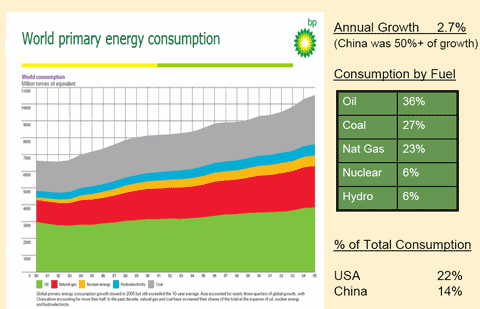
While renewables should still far and away be our top priority, one area that strikes me as (a) important and (b) filled with opportunity is cleaning up coal. A report from the UK's Parliamentary Office of Science & Technology states that as of Dec 2005, 1,000 gigawatts of global electricity come from coal, representing ~39% of worldwide energy. Coal provides 27% of the world's overall energy (i.e. electricity plus transportation), according to BP...

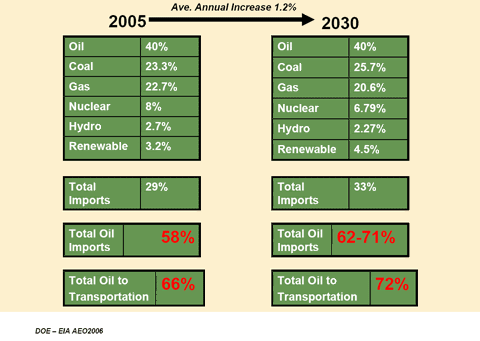
...and 23% of the energy in the U.S. now, rising to 26% by 2030, according to the Dept. of Energy.


So coal is already a huge portion of our energy supply, and China and India's booming economies will want new coal plants to help fuel their growth.

Meanwhile, coal's high carbon content makes it the biggest CO2 emitter per unit of electricity produced. So when you turn on your light switch, you're pumping CO2 into the air just as you are when you turn on your engine. It kind of makes you want to clean up coal, doesn't it??

Some organizations such as Greenpeace have dismissed clean coal as infeasible, throwing their support behind renewables instead. I disagree with their position mainly because they're not viewing the whole picture. Yes, renewables are always better even than "clean coal," but no, coal is not going away tomorrow. It has a huge installed base, and since coal is relatively cheap to produce, the temptation will be there (especially for emerging economies) to bring new coal plants online. We need to try to improve the clean-coal technologies.

My next post on coal will focus on the different technologies and their stages of development. Finally I'll look into economic opportunity, particularly from carbon trading.

To be continued...

Friday, January 4, 2008

Q-Cells and the Future of Solar Photovoltaics

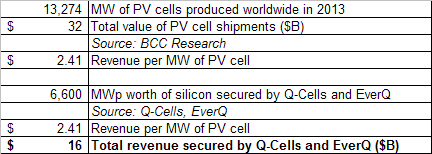
The solar industry is booming. According to this article, "sometime in the next two years, more raw silicon will be going to solar panels than to electronics chips." And according to a report recently released by BCC, the market for solar PV cells will reach $32 B/year in 2013. Good news, but there's one catch: supplies of polysilicon, one of the key ingredients in many solar PV panels, are growing tight. The bottleneck isn't the raw material (sand), but rather the production capacity for refining sand into polysilicon.

This means two things: (1) a scramble among polysilicon PV cell manufacturers for supply, and (2) a move towards thin-film technologies, such as CIGS, which don't use silicon or use much less of it.

One company that's moved to address both of these issues is Q-Cells out of Germany. They've signed a long-term supply agreement with China's LDK Solar, locking in a supply of 43,000 tons of silicon wafers through 2018. And EverQ, their joint venture with Evergreen Solar and Norway's REC, has locked in supplies of up to 2,100 tons of polysilicon per year through 2015. That translates to enough silicon for an output of roughly 6,600 megawatt peak.

A quick back-of-the-envelope analysis shows that this translates to securing access to enough raw materials to convert into $16 billion of revenue, using the revenue per MW of PV cell in 2013 from the BCC report I mentioned above. So the polysilicon shortage shouldn't dent their growth:


Meanwhile, their subsidiary companies are ramping up thin-film technologies. Calyxo makes cadmium telluride PV cells and Brilliant 234 produces thin-film silicon modules. Solibro GmbH, a joint venture with Solibro AB, is a CIGS (cadmium indium gallium selenide) manufacturer.

This is an impressive company that seems to have all the bases covered. I'd keep an eye on them.

Saturday, December 29, 2007

Finding the True Cost of Coal and Oil - The Feed-In Tariff

When it comes to renewable energy, the U.S. is a follower, not a leader. Our solar markets lag behind Germany, Japan, and other countries. We're addicted to cheap energy, primarily because the free market’s invisible hand is not just invisible, it’s also sometimes blind. Sometimes the cheapest option isn’t really the cheapest, which is especially true with polluting forms of energy such as coal and oil. They contain hidden costs, such as damage to the environment as well as dependence on unreliable foreign governments. These are the classic 'externality' case studies from Economics 101. And the classic solution to the classic externality case is that government steps in and 'moves the supply curve' over to reflect the true costs of the supply.

While many states in the U.S. have implemented net metering (which would allow customers to get refunds for providing their own clean energy), the Federal government just missed the chance to do more to encourage utility-scale renewable energy by failing to extend the tax credit for solar energy, which expires at the end of 2008. Meanwhile, European and other governments have been taking gigantic steps forward by implementing feed-in tariffs. A feed-in tariff essentially means that you get paid more than the going rate of electricity for each kWh of clean energy that you (or a utility-scale renewable plant) feed in to the grid.

Germany is the leader, having begun feed-in tariffs in the 90s. In Spain, the generator of solar or wind energy gets paid 5x the base rate of fossil-generated electricity for up to 25 years, after which the rate drops by 20% for the life of the system. And in Ontario Canada, the utility is obligated to pay 42 Canadian cents per kWh for solar electricity, roughly four times the price of retail electricity rates. And Italy has just passed feed-in tariff legislation that should spur huge market growth there for solar and other renewables.

So why hasn’t the U.S. government implemented feed-in tariffs? The answer may be lack of political will, or it may be the sheer strength of the Coal and Oil lobbies. Another reason may be that we rarely look to our government to solve our problems. Here in the U.S. we often bristle when someone suggests that government should solve our problems instead of the free market. We're too independent.

But in this case we may be wrong… I would argue that government action is needed. To demonstrate the point, what if instead of the government stepping in we brought in the lawyers (after all, what could be more American than that?)?

Imagine plaintiff attorneys across the U.S. banding together for the largest class-action lawsuit in history. Forget Big Tobacco, I’m talking about a multi-trillion dollar suit against Big Oil and Big Coal for global warming, and Big Oil for funding terrorism (I know, a bit sensationalist, but then again this is a lawsuit we’re talking about). Think about the trillions of dollars of damage that have been done to resources we all share, such as the earth, such as the air and the water, such as our lungs and our health. If we factored the price of that settlement into the price of oil and coal, maybe the gallon of gas would cost $10 or more, and the kWh of energy from coal would cost $0.40, not ten cents. Then our free market would wake up and build solar, wind, and even nuclear power plants by the hundreds. Then we’d ditch our 15 MPG SUVs and demand and buy the electric cars and plug-in hybrids by the millions.

But this is, for now, just a fun case study. A sturdy feed-in tariff enacted by the federal government, or by states individually, could accomplish the same results as that class-action lawsuit and help us avoid the future hidden costs of coal and oil.

Wednesday, December 26, 2007

Solar: V-shaped Christmas Gift

One of my goals in this blog is to avoid, as much as possible, the pitfall of overhyping every purported advance to come along in the alternative energy space. The reason this is a pitfall is that critics can then claim, "oh, that's really not going to change the game... a 10% improvement does nothing when you need to reduce the cost of solar by 67% to make it competitive with coal," and they promptly shift their focus elsewhere.

But I want to point out an article today as a good example of what I see as an overall trend in the alt energy space. In this article, researchers at Stanford claim that a relatively simple step, creating v-shaped PV cells, could increase efficiency of the cells by up to 50%. I find simple advancements like this fascinating not because they offer The Answer by themselves, but because the answer is going to come from a bundle of simple advancements such as this one. There may be ten different areas (shape of the cell, placement, mirrors, new cell technology such as CIGS, etc.) where incremental improvements will be made. Even if you only achieve 10% improvements in ten different areas, the cumulative effect can be massive, and in ten or twenty years we could see a world where people scoff at coal as being too expensive, never mind too dirty.

So without placing too much hope in any one of these advances, it's still great to see them happen.

Thursday, December 20, 2007

Battery Technology - Nanotech Breakthrough

Plug-in hybrids and electric cars are the future, period. Why the future is not here has a lot to do with people's skepticism regarding battery technology. You always hear about limited range, size, and safety concerns. I've been of the opinion, however, that battery technology is going to improve, and when it does the economics of an electric car are going to be undeniable (see my post on how the cost of gasoline will soon outstrip the cost of the car, if it doesn't already).

That's why today's Science Daily article on nanowire technology is so exciting. Researchers at Stanford, led by Yi Cui, have come up with a new structure for lithium ion batteries using silicon nanowires as opposed to carbon for the anode. This allows the battery to store up to 10 times the charge of existing Li-ion batteries, and the nano-structure prevents the degradation of the silicon.

This would represent a geometric improvement in the capabilities of batteries, a technology that's already quite close to making electric cars feasible. This kind of breakthrough is what's going to make the electric car a no-brainer. Obviously there's going to have to be testing done on a battery like this, but improvements like these leave me optimistic that the battery technology will improve, and the electric car will have its day. If I were a big auto manufacturer I'd invest a lot of money now to get a head start on this market.

Tuesday, December 18, 2007

The Energy Bill Passes - A Great Step in the Right Direction

Good news. The energy bill that included the biofuel mandate I talked about last week passed the House today, 314 to 100. This is an excellent step in the right direction, partially because of the biofuels, but also because it includes the first big boost in fuel economy in 32 years, from 25 MPG to 35 by 2020. Obviously, if your chief issue is the environment you're pretty happy about this.

But if your chief issue is the economy or homeland security, you should also be ecstatic. Here's why:
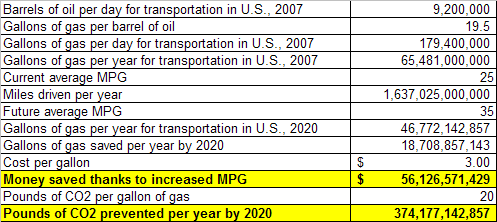
We use 9.2 million barrels of oil a day for transportation, which equals roughly 65 billion gallons of gas a year. If the average MPG is 25, that gas gets us 1.6 trillion miles. But with a MPG of 35, we can travel the same distance for only 47 billion gallons of gas, saving us $56 billion per year, not to mention the 374 billion pounds of CO2 we won't pump into the air each year.


So one way to think of this is as a $56 billion per year TAX CUT. That's a ton of money that the average Joe and Jane will cycle back into other goods in our economy, and not into the hands of governments that hate us.