
Well I'm back after a little hiatus. Sorry I've been gone so long! I just took a new job at Go Green Solutions in Pasadena in mid-March. I've thrown myself headlong into the new position and as a result have let my blog posting responsibilities slide a bit. But not to worry, my new job dovetails well with what I've been talking about here in Energy Crunch (did the company's name give it away?) so I'll be able to continue to bring my insights to this column, as my throngs of readers will no doubt be assured to hear.
For today I just wanted to point out this article which gives further hope that soon solar power will be cheaper than fossil fuels, and the stampede to renewables will begin in earnest.
Enjoy the article, and check back now that I've got my schedule back under control a little bit.
Showing posts with label solar. Show all posts
Showing posts with label solar. Show all posts
Wednesday, April 16, 2008


Friday, January 4, 2008
Q-Cells and the Future of Solar Photovoltaics
The solar industry is booming. According to this article, "sometime in the next two years, more raw silicon will be going to solar panels than to electronics chips." And according to a report recently released by BCC, the market for solar PV cells will reach $32 B/year in 2013. Good news, but there's one catch: supplies of polysilicon, one of the key ingredients in many solar PV panels, are growing tight. The bottleneck isn't the raw material (sand), but rather the production capacity for refining sand into polysilicon.
This means two things: (1) a scramble among polysilicon PV cell manufacturers for supply, and (2) a move towards thin-film technologies, such as CIGS, which don't use silicon or use much less of it.
One company that's moved to address both of these issues is Q-Cells out of Germany. They've signed a long-term supply agreement with China's LDK Solar, locking in a supply of 43,000 tons of silicon wafers through 2018. And EverQ, their joint venture with Evergreen Solar and Norway's REC, has locked in supplies of up to 2,100 tons of polysilicon per year through 2015. That translates to enough silicon for an output of roughly 6,600 megawatt peak.
A quick back-of-the-envelope analysis shows that this translates to securing access to enough raw materials to convert into $16 billion of revenue, using the revenue per MW of PV cell in 2013 from the BCC report I mentioned above. So the polysilicon shortage shouldn't dent their growth:

Meanwhile, their subsidiary companies are ramping up thin-film technologies. Calyxo makes cadmium telluride PV cells and Brilliant 234 produces thin-film silicon modules. Solibro GmbH, a joint venture with Solibro AB, is a CIGS (cadmium indium gallium selenide) manufacturer.
This is an impressive company that seems to have all the bases covered. I'd keep an eye on them.
This means two things: (1) a scramble among polysilicon PV cell manufacturers for supply, and (2) a move towards thin-film technologies, such as CIGS, which don't use silicon or use much less of it.
One company that's moved to address both of these issues is Q-Cells out of Germany. They've signed a long-term supply agreement with China's LDK Solar, locking in a supply of 43,000 tons of silicon wafers through 2018. And EverQ, their joint venture with Evergreen Solar and Norway's REC, has locked in supplies of up to 2,100 tons of polysilicon per year through 2015. That translates to enough silicon for an output of roughly 6,600 megawatt peak.
A quick back-of-the-envelope analysis shows that this translates to securing access to enough raw materials to convert into $16 billion of revenue, using the revenue per MW of PV cell in 2013 from the BCC report I mentioned above. So the polysilicon shortage shouldn't dent their growth:
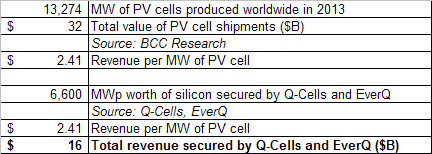
Meanwhile, their subsidiary companies are ramping up thin-film technologies. Calyxo makes cadmium telluride PV cells and Brilliant 234 produces thin-film silicon modules. Solibro GmbH, a joint venture with Solibro AB, is a CIGS (cadmium indium gallium selenide) manufacturer.
This is an impressive company that seems to have all the bases covered. I'd keep an eye on them.
Wednesday, December 26, 2007
Solar: V-shaped Christmas Gift
One of my goals in this blog is to avoid, as much as possible, the pitfall of overhyping every purported advance to come along in the alternative energy space. The reason this is a pitfall is that critics can then claim, "oh, that's really not going to change the game... a 10% improvement does nothing when you need to reduce the cost of solar by 67% to make it competitive with coal," and they promptly shift their focus elsewhere.
But I want to point out an article today as a good example of what I see as an overall trend in the alt energy space. In this article, researchers at Stanford claim that a relatively simple step, creating v-shaped PV cells, could increase efficiency of the cells by up to 50%. I find simple advancements like this fascinating not because they offer The Answer by themselves, but because the answer is going to come from a bundle of simple advancements such as this one. There may be ten different areas (shape of the cell, placement, mirrors, new cell technology such as CIGS, etc.) where incremental improvements will be made. Even if you only achieve 10% improvements in ten different areas, the cumulative effect can be massive, and in ten or twenty years we could see a world where people scoff at coal as being too expensive, never mind too dirty.
So without placing too much hope in any one of these advances, it's still great to see them happen.
But I want to point out an article today as a good example of what I see as an overall trend in the alt energy space. In this article, researchers at Stanford claim that a relatively simple step, creating v-shaped PV cells, could increase efficiency of the cells by up to 50%. I find simple advancements like this fascinating not because they offer The Answer by themselves, but because the answer is going to come from a bundle of simple advancements such as this one. There may be ten different areas (shape of the cell, placement, mirrors, new cell technology such as CIGS, etc.) where incremental improvements will be made. Even if you only achieve 10% improvements in ten different areas, the cumulative effect can be massive, and in ten or twenty years we could see a world where people scoff at coal as being too expensive, never mind too dirty.
So without placing too much hope in any one of these advances, it's still great to see them happen.
Tuesday, December 18, 2007
NanoSolar Hits a Milestone
I blogged before about NanoSolar's exciting prospects, and today they announced that they've shipped their first product and received their first check of product revenue.
In their announcement they make the claim that they'll be able to produce at $0.99/watt, which is on the way to the $0.30 they predicted before. If you'll recall, my calculations used a more conservative $0.60 and showed that they were on track for utility-scale power generation competitive with coal. So their claim today of $0.99 is a big milestone.
Funny enough, you can buy one of their first commercial panels on eBay. It's up to $7,350 right now. If they could just get that much for each panel, that'd be a pretty profitable model...
In their announcement they make the claim that they'll be able to produce at $0.99/watt, which is on the way to the $0.30 they predicted before. If you'll recall, my calculations used a more conservative $0.60 and showed that they were on track for utility-scale power generation competitive with coal. So their claim today of $0.99 is a big milestone.
Funny enough, you can buy one of their first commercial panels on eBay. It's up to $7,350 right now. If they could just get that much for each panel, that'd be a pretty profitable model...
Monday, November 19, 2007
Nanosolar Goes Macro
Nanosolar has been getting a lot of press recently, and the reports are certainly encouraging. This article mentions "30 cents a watt" production costs and a production facility that can crank out 430 MW worth of cells per year. Impressive numbers.
A quick check of the math shows that these are some saliva-inducing figures, even if you assume that it costs double the quoted price to get the panels configured in power-plant-size arrays. Another key assumption is the longevity of the panels... do they last a year, 25 years, 100 years?

As you can see, if they last just 15 years they're beating out coal, which would mean Nanosolar has a [come on Mark, fight it, FIGHT IT... ah to heck with it] very bright future. I'd have to think that becoming a power-plant producer that uses this technology would be extremely lucrative, which is probably why a lot of people are drooling on the sidelines waiting to see if Nanosolar can deliver on these big promises. I know I am.
A quick check of the math shows that these are some saliva-inducing figures, even if you assume that it costs double the quoted price to get the panels configured in power-plant-size arrays. Another key assumption is the longevity of the panels... do they last a year, 25 years, 100 years?

As you can see, if they last just 15 years they're beating out coal, which would mean Nanosolar has a [come on Mark, fight it, FIGHT IT... ah to heck with it] very bright future. I'd have to think that becoming a power-plant producer that uses this technology would be extremely lucrative, which is probably why a lot of people are drooling on the sidelines waiting to see if Nanosolar can deliver on these big promises. I know I am.
Tuesday, November 13, 2007
Fun With Balloons - Correction
Correction. My last blog post was quite excited about Cool Earth's new inflatable solar concentration technology, which lowered the cost per Watt for solar to $0.20, and I found the idea too good to be true. Well, I did some further research and found a CNET article with the following quote:
"Cummings [Cool Earth's founder and CTO] envisions that these balloons will be cabled together above farmland and would be replaced every year"
Darn. I was hoping the balloons could stick around for at least a few years. If they have to be replaced every year, the cost per kWh becomes a bit higher. But what's interesting is that it's still cheaper than oil, getting close to natural gas, while still quite a bit more pricey than coal. But if they could make those balloons last four years, the price per kWh is about what coal costs!
Here are my rough calculations (I'm not a commodities trader, so I apologize if the prices aren't up to the minute):

I, for one, am rooting for them to make those balloons a little more durable.
"Cummings [Cool Earth's founder and CTO] envisions that these balloons will be cabled together above farmland and would be replaced every year"
Darn. I was hoping the balloons could stick around for at least a few years. If they have to be replaced every year, the cost per kWh becomes a bit higher. But what's interesting is that it's still cheaper than oil, getting close to natural gas, while still quite a bit more pricey than coal. But if they could make those balloons last four years, the price per kWh is about what coal costs!
Here are my rough calculations (I'm not a commodities trader, so I apologize if the prices aren't up to the minute):

I, for one, am rooting for them to make those balloons a little more durable.
Fun With Balloons!
As I say in my introduction above, I'm interested in solutions that will be real, achievable, and market-driven. So with that last part in mind, let's see if we can have some fun with balloons and make some money in the process.
Cool Earth claims to have technology, called Inflatable Solar Concentration, that will reduce the price for solar energy to roughly $0.20 per Watt within three years (for comparison purposes, check out my posts below for the solar stations that are producing it at $2 to $3.20 per Watt). Wow.
So let's say you had a really big back yard and you wanted to buy some balloons and create your own power plant. Could you make money? Let's run the numbers:

So we raised $200k, bought 2,000 balloons, strung them together, and we're cranking out a Megawatt. Assuming they capture energy 9 hours a day, we're selling 3.3 M kWh back to the grid. At 7 cents per kWh, we make our money back plus a profit in year one. And each successive year is pure profit.
Is it just me or does this sound too good to be true? I'm going to give these guys a call and see if I can buy some balloons.
Cool Earth claims to have technology, called Inflatable Solar Concentration, that will reduce the price for solar energy to roughly $0.20 per Watt within three years (for comparison purposes, check out my posts below for the solar stations that are producing it at $2 to $3.20 per Watt). Wow.
So let's say you had a really big back yard and you wanted to buy some balloons and create your own power plant. Could you make money? Let's run the numbers:

So we raised $200k, bought 2,000 balloons, strung them together, and we're cranking out a Megawatt. Assuming they capture energy 9 hours a day, we're selling 3.3 M kWh back to the grid. At 7 cents per kWh, we make our money back plus a profit in year one. And each successive year is pure profit.
Is it just me or does this sound too good to be true? I'm going to give these guys a call and see if I can buy some balloons.
Monday, November 12, 2007
A Small Effort Can Have Big Effects
So I've been asked, "you talk a big game about energy independence through renewables, but it seems so hard and expensive. Isn't it just a pipe dream?" (ok, no one asked me that... I asked myself) In truth, it's far far more expensive for us NOT to develop renewable energy. I talked about a gas tax, and then I came across this article that agrees with me, basically saying that while we've dithered and fought over what to do with our energy policy, the price of oil has jumped from $40 to $100. And there are signs that it could go to $200 or more. We're absolutely shooting ourselves in the foot with every dollar we don't spend right now on renewable energy, dollars that in the future will go three and fourfold into the pockets of foreign governments hostile to us. What a waste.
Let's look at what a little tiny change now could do for us when applied over ten years. I'm going to use the example of my 20-cent per gallon gas tax below, and say that each year we took those proceeds and built a solar plant, using the cost model of the Victorville solar energy station. Are you ready?

Doesn't that just kill you? $10 bucks a month and in ten years those 13 million people could get 40% more energy from solar, using existing technology. Considering SoCal Edison energy is already 18% renewable, this would bring the total near 60%! Victorville is being built right now, with available technology. It's not a pipe dream. Why are we not building a hundred of these, and a hundred wind and geothermal stations as well? The cost of the alternative is about to get more expensive than we can imagine.
Let's look at what a little tiny change now could do for us when applied over ten years. I'm going to use the example of my 20-cent per gallon gas tax below, and say that each year we took those proceeds and built a solar plant, using the cost model of the Victorville solar energy station. Are you ready?

Doesn't that just kill you? $10 bucks a month and in ten years those 13 million people could get 40% more energy from solar, using existing technology. Considering SoCal Edison energy is already 18% renewable, this would bring the total near 60%! Victorville is being built right now, with available technology. It's not a pipe dream. Why are we not building a hundred of these, and a hundred wind and geothermal stations as well? The cost of the alternative is about to get more expensive than we can imagine.
Thursday, November 8, 2007
Solar calculations - part 2
OK, I did a bit more research into the cost of solar power by looking into the Victorville, CA Solar Power station. The plant plans to build 20,000 Stirling generators, producing 25 kW each. The cost at such production levels is estimated to be $50-80,000 per generator, which is a cost per watt between $2 and $3.20, a bit lower than the Nevada One figures I mentioned in my post below.
So this stuff is realistic.
What's even more interesting is that the plant will earn back its cost in 15 years by selling power at ~7 cents/kWh, and after that it's going to "mint money," as this Business Week article puts it.
So this stuff is profitable. My question is, what's the holdup?
So this stuff is realistic.
What's even more interesting is that the plant will earn back its cost in 15 years by selling power at ~7 cents/kWh, and after that it's going to "mint money," as this Business Week article puts it.
So this stuff is profitable. My question is, what's the holdup?
Wednesday, November 7, 2007
Solar calculations - part 1
This article is an interesting exercise in figuring out the scale of the solution. But I can simplify the math. He's basically saying the Nevada Solar One project cost $240M and puts out 64 MW of energy. That's $3.75 per watt. So he could have just skipped all his intermediate steps and said: $68 B (what Bush is asking for the Iraq war right now) buys you 18 GW. The U.S.
So why is this Economist article so pessimistic that solar won't amount to more than 1% of our energy needs in the next decade? There must be production limitations (i.e. we can only make so many panels per year currently).
Am I missing something?
So why is this Economist article so pessimistic that solar won't amount to more than 1% of our energy needs in the next decade? There must be production limitations (i.e. we can only make so many panels per year currently).
Am I missing something?
Subscribe to:
Posts (Atom)

