Showing posts with label plug-in hybrids. Show all posts

Thursday, May 1, 2008

The Shift Begins: Carmakers Respond to Customers Who Are Responding to Gas Prices

I've talked about it here at EnergyCrunch before, but I think we're now seeing some real-world evidence. My previous blog post talked about how consumers will start to change their patterns once they realize that the gas will cost more than the car they're buying. I mentioned $6/gallon as when that would happen. Now it seems to be starting to happen much sooner.

An article in today's New York Times reports that consumers are buying smaller cars (it would be hybrids, plug-in hybrids, and electric vehicles if more of those were available). Check out this astonishing real-world ripple effect:

"Light truck sales fell a staggering 32 percent at G.M., 25 percent at Ford, 19 percent at Nissan and 16 percent at Toyota."

"G.M. said this week that it planned to cut production of its full-size pickups by 88,000 units and of its large S.U.V.s by 50,000 units this year."

There you have it. Oil goes up, gas price goes up, automakers almost immediately change the blend of vehicles they're producing.

Simultaneously, the AP reported that hybrid sales went up 38% last year even as overall vehicle sales were down 3%.

If I were the Big 3 (or any automaker), I'd be fast-tracking whatever plug-in hybrid or electric car research I already had underway. And if I didn't have any underway, well I'd be hanging up a For Sale sign (or shorting my own stock) because the game's about to be over.

Thursday, December 13, 2007

The Biofuel Mandate - Offsetting 25-55% of the Oil We Use for Transportation

I haven't discussed biofuels yet, partially because I'm pretty clearly excited about electric and PHEV vehicles. But it would be a mistake to think that electric vehicles or plug-in hybrids are going to come in and gain the whole market right off the bat. Their introduction may certainly be encouraged by rising oil prices, but you could say the same thing about biofuels. So what about biofuels? What does the market look like?

Well, it looks pretty huge is what it looks like. This article discusses the pending legislation that would mandate the use of 36 billion gallons of ethanol motor fuel by 2022. 36 billion gallons at a few bucks a gallon could mean this is a $100 billion market. And since 21 billion of those gallons are supposed to come from advanced biofuels (e.g. switchgrass, cellulosic, and my favorite, algae) there's a very large market that's being invented right now. That's a space I'd bet on.

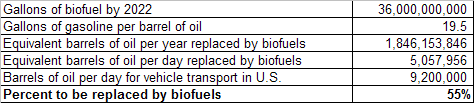
That article also claims that 36 billion gallons equals 15% of U.S. gasoline consumption. My calculations show that it's actually between 25% and 55%, depending on how many gallons you can get from a barrel of oil. I've seen 19.5 quoted a lot of places, which would mean that 36 B gallons a year replaces 5 million barrels of oil per day. Since we currently use 9.2 million barrels/day for vehicle transportation, that would mean we're replacing 55% of the oil we use for transportation.


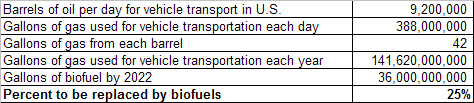
But this article from the AP claims that our 9.2 million barrels of oil per day equals 388 million gallons. That's more like 42 gallons per barrel of oil, which means biofuels would replace 25% of the oil we use for transportation.


Either way, biofuels will be a big market, and will go a long way toward getting us off foreign oil. If electrics and PHEVs can meet them halfway, the future is looking good on the independence from foreign oil front, and pretty darn good on the greenhouse gas front.

Wednesday, November 28, 2007

Marketing the Plug-in Hybrid - Emphasize Savings

As I read articles and press releases about plug-in hybrids, I've noticed the topic of expensive batteries mentioned several times, with cost estimates ranging from $1,200 to $3,600. The "Green Car Journal" recently featured an essay claiming that "battery costs remain the biggest obstacle to the rapid introduction of PHEVs." The author was quite ingenious and came up with good ideas on how to overcome this obstacle, including a very clever one involving utilities owning the batteries and 'leasing' them for free to the owners, with the utility gaining, well utility, by being better able to manage grid resources.

Okay, very clever, but I think there's a much simpler solution: marketing. Right now the average driver probably thinks, "well, I'll save a few bucks here and there with a plug-in, but it's going to cost me so much more to get the car..." And no one's telling him "the battery will save you $3,700 in 5 years!" Don't believe me? Let's do the math.

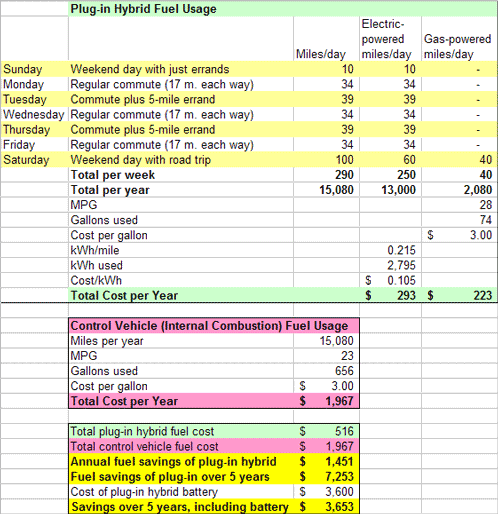
Let's look at a typical driver's fuel usage on a plug-in and a regular internal combustion motor. On Sunday, he just does some around-town driving, adding up to 10 miles. Three days of the week he just goes back and forth to work (34 miles). Two days of the week he adds five miles to his commute to run some errands (39 miles). On the 7th day he heads out for a 100 mile road-trip. Over a year this adds up to 15,000 miles. But as you can see in the graph below, if he plugs in every night, the first 60 miles of each day are electric, with gas kicking in only on his long road trips each Saturday. I used $3/gallon gas, and I figured that the gas he does use is at a higher MPG, because it's kicking in on the freeway on those long road trips. (Click to enlarge the image).


It's pretty easy to see that this average commuter will save almost $1500 a year! Even paying for an expensive $3,600 battery, he saves $3,653 over five years. And if the price of gas jumps fifty cents, he saves over $5,000 over five years.

Now isn't that way more compelling to the consumer than fretting about how expensive the battery is?

The L.A. Auto Show - The Year of the Green Vehicle

The "green" theme was a big presence at the L.A. Auto Show this year. So were gorgeous Ferraris, Maseratis, and Lamborghinis, but I was just there to check out the environmentally-friendly cars, right? Below are some of the cars we saw along with some quick thoughts. (Props to my photographer and girlfriend Kate... some of the shots she took were magazine-quality!).

Here's the Tesla. All-electric, 0-60 in 3.9 seconds, good-looking car... here's hoping they deliver on their promises. See my thoughts in the post below.


Chevy is heavily hyping their "gas friendly to gas free" concept, and they had the Chevy Volt on display (right). They call it an electric car, but it's really a plug-in hybrid electric vehicle (PHEV). It's got an electric range of 40 miles, which will work for 75% of commuters, and then after that gas (or ethanol) kicks in to extend your range. I'm a big fan of this technology, since it solves a big part of the problem now, the "fueling" infrastructure is already in place, and battery technology will only improve making PHEVs into BEVs (battery-only) and getting us gas-free.
Some stats on the Volt:
Recharge time: 6 to 6.5 hours.
Battery life: 10 years.
0-60: 8 to 8.5 seconds
Launch date: 2010

My apologies to Volvo. They had a Volvo C30 ReCharge there, but I didn't get a picture. So I borrowed one from their website (right). The ReCharge is a PHEV that promises a 60-mile range with a full battery recharge in only 3 hours. Also, apparently a quick charge of 1 hour should get you 30 miles or so. Not bad.
I really liked this car because it looks normal. I don't hate the look of the Chevy Volt, but why does it have to look so weird? Props to Volvo for integrating advanced PHEV technology so well into a normal-looking car.

There were a couple hydrogen cars there, a technology I don't like for two main reasons: (1) it's far inferior to battery electric vehicles (BEVs) or plug-in hybrids (PHEVs) for the simple reason that it requires a whole infrastructure of hydrogen fueling stations to be built, whereas sockets are already ubiquitous, and (2) up to 75% of the energy is lost in generating, compressing/liquefying, and transporting the hydrogen.

But here they are: the Honda FCX Clarity Fuel Cell car, which will start with a limited lease plan in 2008.


And GM's Fuel Cell SUV:


And then, just for fun, the Lamborghini. Man, I love lambos. Probably not the solution to the Energy Crunch, but great to look at.