Thursday, July 3, 2008

Ocean Iron Fertilization - Doing the Math

I wanted to revisit the Ocean Iron Fertilization idea I mentioned in my last blog post, to run the numbers and see if it's worth the controversy. I found out some interesting things.

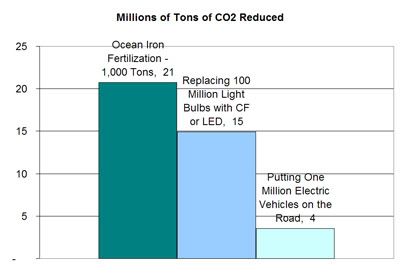
I compared three approaches for reducing CO2: (1) OIF, (2) replacing 100 million incandescent bulbs with compact fluorescent or LED bulbs, and (3) replacing 1 million gas-guzzling cars with electric vehicles. The results are surprising. 1,000 tons of iron seeded into oceans beats both other options combined. And that's a small amount considering scientists are thinking about seeding 200,000 tons of iron into the oceans.

How do these compare to the size of the problem at hand. Consider that in 2030 the U.S. will emit 3.3 billion tons of CO2 into the air. So 40 million tons is barely over 1%. Now think that it would take 159,000 tons of iron to sequester 100% of the U.S.'s 2030 CO2 levels, and ocean iron fertilization begins to sound very intriguing, maybe even worth the risks.

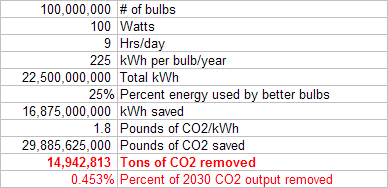
Here are the rough calculations I did:

First off, 1,000 tons of iron seeded into algae blooms could sequester roughly 21 million tons of CO2.



Replacing 100 million light bulbs with more efficient compact fluorescent or LED bulbs could save 15 million tons of CO2.


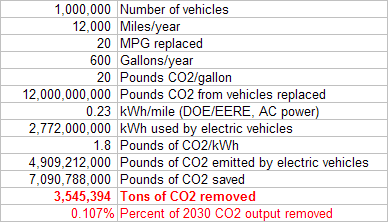
A shocking finding for me was how little CO2 would be prevented by putting a million EVs on the road. Granted, part of this is because right now a big chunk of electricity comes from burning coal. If we moved more of our electricity generation to renewables, this number might increase. But right now a million EVs would remove less than 4 million tons of CO2, the same as 200 tons of iron fertilization.


On this rough evidence, OIF is definitely worth further investigation.

Monday, June 23, 2008

Forget Iron Man, How About Iron Algae?

The Ocean Iron Fertilization (OIF) Controversy

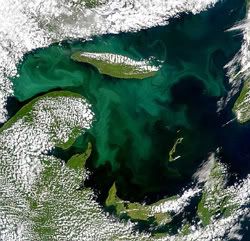
Algae, that wonder-plant that could be the biofuel of the future, could now also help solve the energy crunch problem from another angle: carbon sequestration. Simply put: there are many areas of ocean that have all the requisite elements for algae growth except iron. From time to time dust storms blow iron-rich soil into these oceans, just enough to satisfy the algae's 106:16:1:0.001 Carbon-Nitrogen-Phosphorous-Iron ratio, and huge algae blooms spring up (like the one pictured at right). This ratio means that for every atom of iron, 106,000 carbon atoms are bound into the algae. Or 83,000 pounds of CO2 for 1 pound of iron. The idea is that then 20-30% of the algae biomass sinks below the thermocline (100-200 meters) effectively sequestering the carbon from the atmosphere for hundreds of thousands of years.

I think the idea is a wonderful one in theory. But I would urge some caution when messing around with Mother Nature. A couple of anecdotes come to mind (although I'm sure you could find your own examples by throwing a rock in the air).

First is the story of saltcedar in New Mexico. In the early 20th century they brought in this non-native, deep-rooted species to solve the erosion problems they were having near the Pecos and Rio Grande rivers. The problem was that saltcedar was so successful, and so deep-rooted, that it spread like wildfire and began drinking the rivers dry. Now New Mexico spends millions of dollars a year in a near-futile effort to remove the plants and preserve water (if they're hard for nature to erode, then they're hard for us to remove).

Another story comes from my girlfriend's hometown of Medicine Lake, Montana. In the 30s and 40s they planted crested wheatgrass, a non-native prairie grass, in the Medicine Lake Wildlife Refuge thinking that it would provide a better shelter for wildlife. It proved too successful, growing so thick and so widespread that it's preventing wildlife from nesting there, opposite of the intended effect.

Maybe ocean iron fertilization would also prove too successful, pouring billions of tons of CO2 into the oceans and poisoning fish, replacing one set of problems with another.

In the next post I'll do the math to see whether it's worth exploring.

Wednesday, June 11, 2008

Biofuels: Algae

I've mentioned biofuels before and how they've been mandated to replace 25-55% of the oil we use for transportation. Today I came across an interesting company that has an innovative way to grow biofuels from my preferred liquid fuel source of the future: algae.

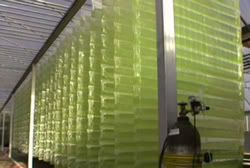
Valcent has developed a closed loop vertical bioreactor (right) which grows algae extremely efficiently. It's really quite clever as it allows the algae to get access to light by funneling it through vertically hanging curtains. The system is closed and therefore conserves water as it avoids the evaporation that occurs in open pond growth systems. Here's a video.

BIOFUEL USAGE
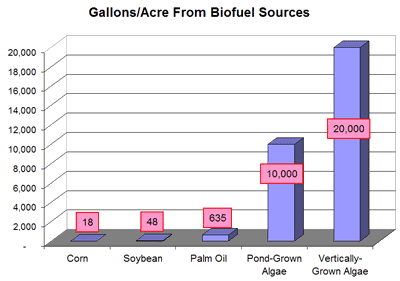
Algae could be the future of biofuels because it's extremely efficient. As much as 50% of its body weight is a high-grade vegetable oil. Different types can also be selected to produce different carbon chains, some better for jet fuel, some better for diesel, etc. The key measure of efficiency for biofuels is gallons per acre. As you can see from the chart on the left, algae crushes the competition.

CO2 SEQUESTERING
Algae is the fastest-growing plant on earth and sequesters the most carbon dioxide as well. So what does this mean about algae's ability to slow global warming by taking CO2 out of the air? Well, it sequesters a whole bunch of CO2, but when we burn it that CO2 is released. The net effect is that it's pretty close to being a carbon-neutral fuel source (not including the fuel involved in transporting it to its destination, i.e. your fuel tank). A U.S. Department of Energy study has shown that the production and use of biodiesel, compared to petroleum diesel, resulted in a 78.5% reduction in carbon dioxide emissions.

COST TO PRODUCE
I found this quote interesting: a Feb. 2007 article on biofuels in MIT's Technology Review said that "today's higher oil prices will make it easier for algae to compete." Note: oil was trading at roughly $60/barrel at that time. Today it's around $135/barrel. Algae is coming fast.

Tuesday, May 20, 2008

The Buzz Grows Louder: The Call to Arms is Coming

Sometimes I think it might be just me, since I'm pretty focused on alternative energies and alternative consumption, but I feel as though the "cleantech" buzz is growing into a dull roar all around me. This is from May 9:
Senator Poses 'Grand Challenges' for Energy Independence. [UPDATE: Full transcript of speech here.]

Senator Lamar Alexander is proposing a bipartisan effort "with the goal of making our nation independent within a generation." Here are the seven grand challenges he outlines:
  • Supporting plug-in electric vehicle development, including "smart metering" by utilities that would allow cheaper rates for overnight battery charging.
  • Making solar power cost competitive with fossil fuels, with the promise of solar thermal power plants.
  • Making biofuels cost competitive with gasoline, particularly ethanol from cellulosic materials.
  • Making more new buildings energy efficient
  • Developing systems to capture and store carbon emissions from coal-fired power plants.
  • Developing ways to safely reprocess and store nuclear waste — the "most important breakthrough" needed to support more nuclear plants.
  • Continuing research on nuclear fusion.
I've discussed several of these initiatives in my blog before. As you know, I'm a big believer in letting market forces and entrepreneurial energies solve these problems, but as Lester Brown points out in his book Plan B 3.0, the market is not recognizing huge chunks of costs associated with fossil fuels (climate change costs, pollution costs, national security costs, total-system-breakdown-from-rising-oil-prices costs, etc). If the market's pricing system is broken, free market forces don't work. That's the problem.

So I've always though that government action would be needed, as much as I'm loathe to depend on it. But the people seem to be demanding it... that's the dull roar I'm hearing.

Why not make this our generation's Manhattan project (although the metaphor I prefer is the moon landing)? Why not invest billions if not hundreds of billions of government dollars into this field? It's still much better than the trillions we'll hand out to governments around the world for oil over the coming years if we don't change.

Any of the three candidates will have a better chance of making alt energy/alt consumption more of a priority than Bush did. But our job is to make sure this is a major campaign issue. After all, whether your hot button is Iraq or the economy, alt energy/alt consumption plays a vital role.

Thursday, May 1, 2008

The Shift Begins: Carmakers Respond to Customers Who Are Responding to Gas Prices

I've talked about it here at EnergyCrunch before, but I think we're now seeing some real-world evidence. My previous blog post talked about how consumers will start to change their patterns once they realize that the gas will cost more than the car they're buying. I mentioned $6/gallon as when that would happen. Now it seems to be starting to happen much sooner.

An article in today's New York Times reports that consumers are buying smaller cars (it would be hybrids, plug-in hybrids, and electric vehicles if more of those were available). Check out this astonishing real-world ripple effect:

"Light truck sales fell a staggering 32 percent at G.M., 25 percent at Ford, 19 percent at Nissan and 16 percent at Toyota."

"G.M. said this week that it planned to cut production of its full-size pickups by 88,000 units and of its large S.U.V.s by 50,000 units this year."

There you have it. Oil goes up, gas price goes up, automakers almost immediately change the blend of vehicles they're producing.

Simultaneously, the AP reported that hybrid sales went up 38% last year even as overall vehicle sales were down 3%.

If I were the Big 3 (or any automaker), I'd be fast-tracking whatever plug-in hybrid or electric car research I already had underway. And if I didn't have any underway, well I'd be hanging up a For Sale sign (or shorting my own stock) because the game's about to be over.

Wednesday, April 16, 2008

Update: New Job!

Well I'm back after a little hiatus. Sorry I've been gone so long! I just took a new job at Go Green Solutions in Pasadena in mid-March. I've thrown myself headlong into the new position and as a result have let my blog posting responsibilities slide a bit. But not to worry, my new job dovetails well with what I've been talking about here in Energy Crunch (did the company's name give it away?) so I'll be able to continue to bring my insights to this column, as my throngs of readers will no doubt be assured to hear.

For today I just wanted to point out this article which gives further hope that soon solar power will be cheaper than fossil fuels, and the stampede to renewables will begin in earnest.

Enjoy the article, and check back now that I've got my schedule back under control a little bit.

Monday, March 10, 2008

Yet Another Reason to Mend Your Polluting Ways

According to an article put out today by the AP, the Catholic church now considers polluting the environment to be sinful behavior. Yet another reason to subscribe to Energy Crunch!